
About two weeks ago, I attended Helsinki EdTech Day, an event mostly filled with people from the industry and start-up scene. Not exactly the type of event I usually go to, but that day I just needed some productive procrastination, something that gave me an excuse not to start working on my manuscript. I expected to hear the usual pitches about AI-driven efficiency, educational disruption, or how new platforms could revolutionise learning. But what I encountered was something refreshingly different. The tone wasn’t about disruption. It was more about stewardship.
Interestingly, the panelists didn’t talk about replacing teachers with technology. They talked about supporting them. They didn’t treat education as a broken system to be fixed by algorithms. Instead, there was a quiet recognition that education is one of the key social institutions still holding their welfare state together. It was clear that the underlying attitude wasn’t the typical Silicon Valley brand of techno-solutionism. It was something more Finnish. In a way, it felt more grounded and human-scaled.
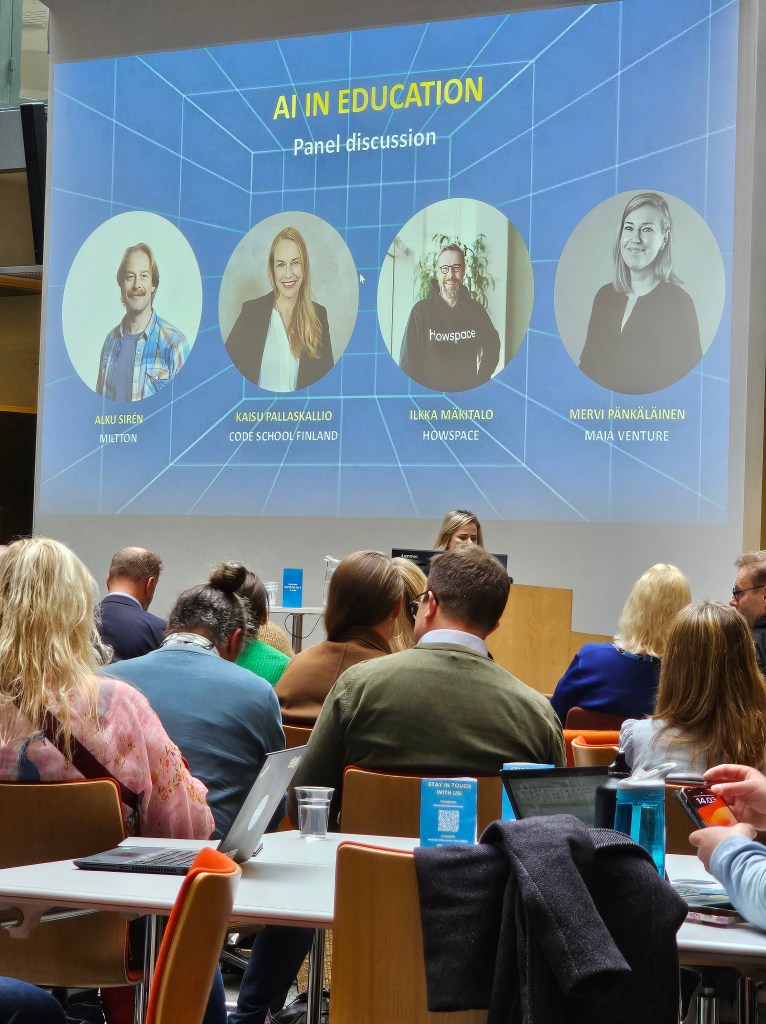
Rather than a parade of apps or products, the conversation kept circling back to pedagogy. The core of education, they said, isn’t technology. It’s pedagogy. It’s the relationship between student and teacher, the emotional and social context in which learning happens. This felt quite different from many global EdTech forums, where technology often takes centre stage and pedagogy is something assumed or outsourced.
There was also some healthy scepticism around the promise of personalisation. While personalising education with AI sounds empowering, several panelists raised a deeper concern: could it erode collaborative learning? Could we, in tailoring everything to individual needs, quietly dismantle shared learning environments? This line of questioning reminded me of researchers back in Oulu, like Sanna Järvelä and her group, who study how learning is co-regulated and socially distributed, not just personalised and internal.
One comment in particular stood out to me. A panelist suggested we should treat large language models like public libraries. Not as proprietary tools locked behind paywalls, owned by private companies, but as public infrastructure. Accessible. Accountable. Shared. That was quite unexpected coming from someone in the industry. The panelists seemed to agree that the discussion about AI wasn’t just a technical one. It was primarily an ethical and political one. Because how we choose to govern AI, especially in education, isn’t just about what works. It’s about what we value. It’s about the kind of world we want to build.
And then, a few days later, I started reading the recently published Empire of AI by Karen Hao. The book completely changed the mood.
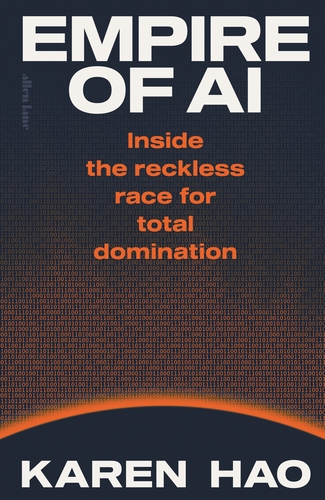
Empire of AI tells the story of a very different ecosystem. Hao’s book is a detailed, gripping account of how OpenAI, arguably the most influential AI lab today, came to be. It’s a story of scale, ambition, and a particular ideology.
Hao doesn’t just describe the technology. She focuses on the people. Many of them are young, gifted, and genuinely brilliant. But she shows how they became entangled in a system that rewards acceleration and dominance. The belief in AGI is treated by some not just as a technical goal but as a moral imperative. Combined with effective altruism and longtermist philosophy, this creates a worldview where scaling AI faster than anyone else becomes an ethical mission.
At the heart of it all is the logic of scale. Bigger models. More data. Faster training. The assumption that intelligence will emerge if only we feed the machine enough data. This mindset is not neutral. It is rooted in a particular vision of the world, one shaped by extractive capitalism, competitive growth, and monopolised power. Hao shows how even academic researchers are pulled into this gravitational field. The funding, the benchmarks, the publication incentives, all of them orbit around scale. She uses the term empire for a reason.
Reading this, I couldn’t help but wonder whether there is a parallel between the cultural messaging behind current AI development and how we, as a society, think about childhood.
Have we absorbed a similar logic in how we raise and measure our children? We reward early bloomers. We chase early milestones. We push for early reading, early coding, early everything. Success, we are told, must happen as young as possible. Learning becomes a performance. Childhood becomes a race. Behind it all is the same belief: faster is better. The same undercurrent that drives scale in AI drives the obsession with precocity in education.
I started to consider how this logic of scale appears across modern education and parenting culture. It shows up in the push for standardised testing and metrics-driven learning, where value is assigned to what can be quickly measured and compared. It drives the popularity of early academic enrichment, shrinking the space for unstructured play. It fuels curriculum compression and early tracking into gifted programs. Even parenting has become a kind of performance optimisation, where every decision is calibrated for outcomes.
At its core, this is the same belief system: that success must be achieved early, that growth must be efficient, and that everything, including human development, should be optimised for productivity and scale.
We celebrate 10-year-old entrepreneurs and 16-year-old university graduates just as breathlessly as we celebrate 100-billion-parameter models. We treat both children and machines as if their worth is tied to how quickly they can outperform expectations. The danger, I think, is the erasure of developmental timing, relational depth, and long-term sustainability. We measure value in acceleration rather than in adaptability or resilience.
This ideology also promotes a false sense of control. With AI, we assume that enough data and compute can produce intelligence. With children, we assume that enough stimulation and structured input can produce excellence. In both cases, the body, the rhythm, and the unpredictability of real growth are treated as inefficiencies to be optimised away.
But when I look into my own research, there is a different story to tell.
I study statistical learning, how humans pick up patterns and regularities from the environment, often unconsciously. I focus on linguistic input, which is why it is called statistical language learning. It is often framed as a shared mechanism between humans and machines. Both are seen as prediction systems. But what I am finding is that in humans, even this basic form of learning is not just computational. It is embodied.
From last year’s experiment, we now have empirical evidence that human statistical learning is modulated by internal state (I really need to start writing the manuscript!!). Heart rate, stress levels, and autonomic nervous system activity all matter. Whether we are regulated or dysregulated makes a difference. Interoception, our sense of the body’s internal signals, affects how learning happens. You cannot just scale up input. The brain needs to be ready. The body needs to feel safe.
This is something AI does not have. Machines process, but they do not feel. They do not regulate. They do not rest. They do not sleep and consolidate. They scale, but they do not grow.
And this is where the critique comes full circle. Whether we are talking about AI systems or our children’s education, the same questions apply. Are we building systems for speed or for sustainability? Are we chasing scale or supporting development? Are we designing for optimisation or for understanding?
Because if human learning is regulated by internal states, if growth is shaped by rhythms and rest, then we need to rethink the logic of scale. Not just in AI that claims to achieve human-level intelligence, but in how we structure childhood, education, and care.
Maybe the future does not need to come faster. Maybe it needs to arrive differently. More grounded. More embodied. And more human.
 livalearning