
Just recently, I’ve been experimenting with the MUSE EEG headband. At first, I was quite skeptical about the tool. Having assisted a postdoc who worked with EEG in the lab, I observed how susceptible EEG is to noise. Even small movements like an eye blink can reduce the quality of your data. Also, EEG electrodes are finicky. If the gel is not applied correctly, it could affect the impedance, and the sensor might not obtain a good signal. So, I wondered how a consumer wearable EEG could provide any meaningful data with its dry electrodes and only four channels, compared to the lab-grade 32 or 64 channels.
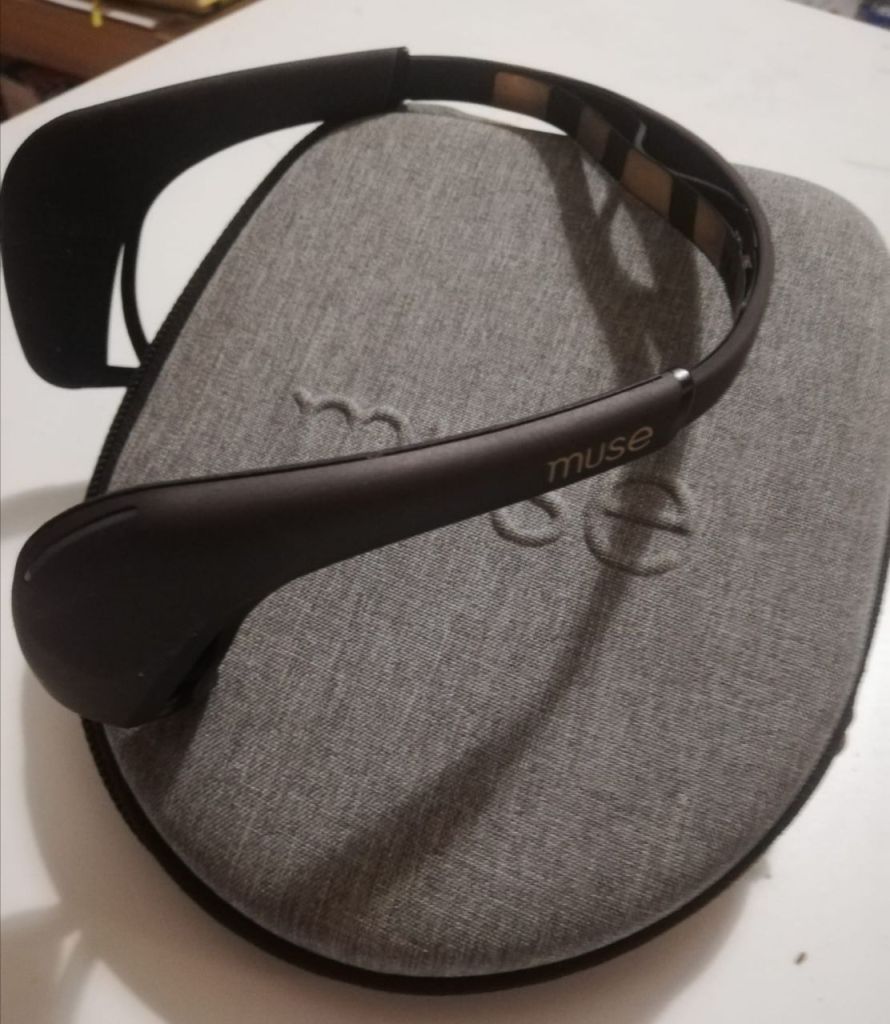
But then, over the years MUSE has gained many loyal users who voluntarily provided their personal brain data. The company relies on the “magic” of big data and machine learning to produce “good” numbers. Some validation studies even found MUSE’s measurements to be quite reliable, and it has become more popular as a research tool outside the lab (Sabio et al., 2022).
MUSE is mainly used to assist meditation. While I’m not an avid meditator, having the MUSE device tempted me to meditate more regularly. I was curious about the data it could produce and how we could experiment with it.
Hardware-wise, I am still experimenting with how to get the sensors to work best. Annoyingly, the headband does not fit snugly on my head. I always get this feeling that the device is about to fall off my nose bridge. Maybe my head circumference is just too small for the device? I had to resort to an additional elastic headband to hold the device in place and gain good signals.
Individual Alpha Frequency (IAF)
I am particularly interested in how MUSE EEG data could provide insights into cognitive aging. Before the summer holiday, I attended a conference held by the Helsinki Brain & Mind research center on Data & AI for Neuroscience. One speaker from Aalto University discussed biomarkers for cognitive aging, highlighting that our alpha band frequency tends to decline as we age. The slowing of the alpha rhythm is an indicator of brain aging in humans (Knyazeva et al., 2018). Numerous studies (e.g., Başar, 2012; Clark et al., 2004) have documented a consistent pattern of alpha rhythm slowing as individuals age.
This information led me to wonder if wearable EEG like MUSE could measure our Individual Alpha Frequency (IAF) power. And according to a recent study, MUSE can reliably measure both Individual Alpha Frequency (IAF) and FAA (Frontal Alpha Asymmetry) (Cannard et al., 2021).
IAF is a specific frequency in your brain’s alpha band that stands out from the rest, and it seems to relate to cognitive performance. Experts often look at peak alpha frequency (PAF) to figure out IAF (Rathee et al., 2020). PAF has practical uses, like distinguishing healthy brains from those with neurological issues such as Alzheimer’s, schizophrenia, or traumatic brain injuries (Başar, 2012). Higher PAF has been connected to better memory performance in healthy adults and even advanced reading skills in children (Rathee et al., 2020).
IAF varies between individuals. Some fall into the lower end of 8-10 Hz, while others reach the higher spectrum of >10-13 Hz. In my home experiment, I estimated my IAF from several datasets of 10-minute meditation each. I downloaded the raw data from a third-party app called Mind Monitor and then analyzed them with the signal processing module in SciPy library. Based on these measurements, my current PAF/IAF is at 11.91 Hz.
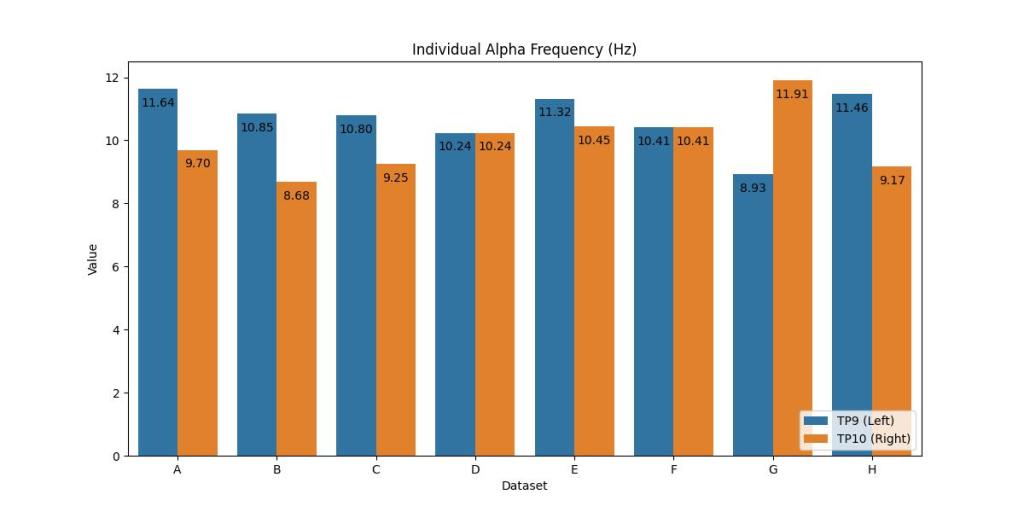
According to the chart below, the average IAF for 30-40-year-olds lies around 10 Hz. So, it appears that my IAF is higher than average for my cohort. Should I be happy about this finding?
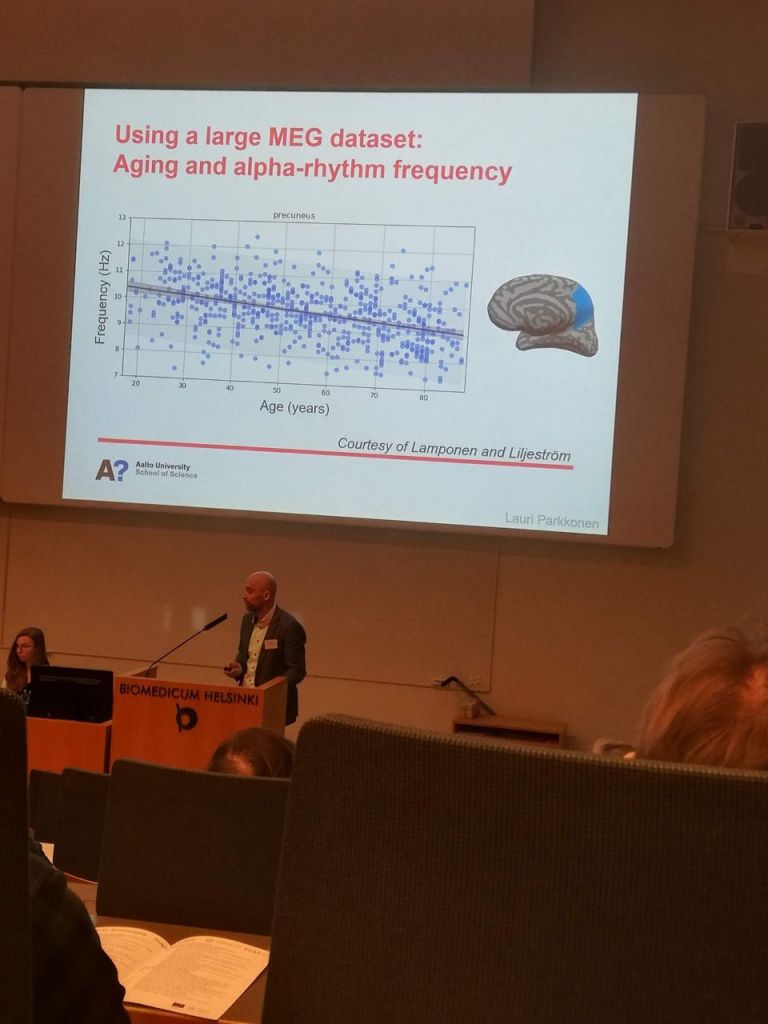
When it comes to cognitive aging, I’m uncertain how to interpret this IAF information. It could be that, although I’m currently on the higher end of the IAF spectrum, my rate of decline is faster. For example, just for the sake of an argument, maybe my IAF was 13 Hz a decade ago, but now it’s 11.9 Hz. Meanwhile, someone else my age might have an IAF that has only dropped from 9.8 Hz to 9.6 Hz over the same period. So basically, I’m still aging faster than him, right?
I do have some reservations about this finding. Is this number meaningful enough, as my IAF was measured only during this recent period? Should we collect more longitudinal personal IAF data?
Overall, the experiment left me both fascinated and frustrated. Interpreting neuroscience data was anything but straightforward, and the lack of literature on using wearable EEG data for cognitive aging detection added to the challenge.
I was also reminded that the frequent loss of signal and discomfort from the headband highlighted the technology’s limitations. The design might not be inclusive enough for those with non-western anthropometric sizes like me. As fun as it is to have this glimpse into our brains without going to a lab or clinic, we must be cautious with the promises these wearable devices hold. We need to be aware of both their potential and pitfalls.
The experiment was a window into the complex interplay of neuroscience, technology, and brain health. Neuroscience findings do not always easily translate to clear clinical applications. Even with advanced technology at our fingertips, there’s still much to learn, interpret, and improve.
As more studies unfold, perhaps we’ll gain clearer insights into how to leverage wearable neurotech devices effectively. But for me now, the simple joy of exploration, combined with a dose of healthy skepticism, might be just the right way to go.
References
Başar, E. (2012). A review of alpha activity in integrative brain function: Fundamental physiology, sensory coding, cognition and pathology. International Journal of Psychophysiology, 86(1), 1–24. https://doi.org/10.1016/j.ijpsycho.2012.07.002
Cannard, C., Wahbeh, H., & Delorme, A. (2021). Validating the wearable MUSE headset for EEG spectral analysis and Frontal Alpha Asymmetry. 2021 IEEE International Conference on Bioinformatics and Biomedicine (BIBM), 3603–3610. https://doi.org/10.1109/BIBM52615.2021.9669778
Clark, C. R., Veltmeyer, M. D., Hamilton, R. J., Simms, E., Paul, R., Hermens, D., & Gordon, E. (2004). Spontaneous alpha peak frequency predicts working memory performance across the age span. International Journal of Psychophysiology, 53(1), 1–9. Scopus. https://doi.org/10.1016/j.ijpsycho.2003.12.011
Knyazeva, M. G., Barzegaran, E., Vildavski, V. Y., & Demonet, J.-F. (2018). Aging of human alpha rhythm. Neurobiology of Aging, 69, 261–273. https://doi.org/10.1016/j.neurobiolaging.2018.05.018
Rathee, S., Bhatia, D., Punia, V., & Singh, R. (2020). Peak Alpha Frequency in Relation to Cognitive Performance. Journal of Neurosciences in Rural Practice, 11(3), 416–419. https://doi.org/10.1055/s-0040-1712585
Sabio, J., Williams, N. S., McArthur, G. M., & Badcock, N. A. (2022). A scoping review on the use of consumer-grade EEG devices for research (p. 2022.12.04.519056). bioRxiv. https://doi.org/10.1101/2022.12.04.519056
 livalearning