
No other animals can use language like humans. So, what is it about the human brain that enables language? The pursuit of this question has inspired researchers from various domains, including cognitive science. Cognitive scientists often use Marr’s three levels of explanation to address a scientific question [1]. At the computational level, for instance, we can define interpreting meaning as one of the computational goals of language. Then, at the algorithmic level, we may need to explain the steps the brain takes to solve the problem: the algorithms to go from phonology, morphology, syntax, and semantics. Finally, at the implementational level, we may be interested in the neurobiology machinery that enables language function. The three levels of explanation provide a framework for analysing language at different levels of abstraction. Answers at each level need to constrain theories and models at every other level, and everything should be coherently consolidated. This article will focus on how this perspective from cognitive science has helped develop our understanding of language in the brain, particularly influential for the shift from the classic model to the current modern models.
The Classic Model
In the late 19th century, Paul Broca identified a patient with enormous difficulty in articulating speech [2]. He was only able to utter the word “tan”. However, he could understand spoken language and appeared fully intelligent. Post-mortem autopsy on Monsieur Tan discovered extensive damage in the left inferior frontal gyrus of his brain, later named Broca’s area [2]. The condition where patients had a problem with speech production yet kept good comprehension of speech was then labelled as Broca’s aphasia [2]. Some years later, Carl Wernicke examined cases of patients with different symptoms and brain lesions. Wernicke’s patients showed effortless speech production but lacked coherence and relevance and poor speech comprehension, later known as Wernicke’s aphasia [2]. Brain lesions were found in the auditory centre in the left temporal cortex, today called Wernicke’s area [2]. Following his findings, Wernicke drafted one of the first models of language in the brain that significantly impacted our understanding of the neurobiology of language.
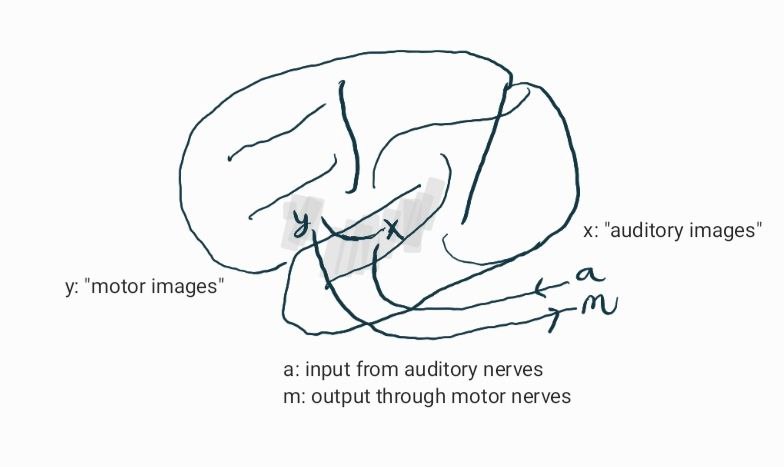
According to Wernicke’s model, a set of interconnected regions instead of just one centre in the brain support speech faculty [2, 3, 4]. In Wernicke’s diagram, the centre for “motor images” of words corresponds to the left frontal cortex. Meanwhile, the centre for “auditory images” of words corresponds to the posterior superior temporal gyrus. The centres receive inputs from the auditory nerves and transmit outputs through the motor nerves. Damages to the “motor images” centre may cause Broca’s aphasia with speech articulation problems. Meanwhile, injury in the “auditory images” centre may cause Wernicke’s aphasia where speech comprehension is lacking. Wernicke also hypothesised that certain brain fibres connected these two centres anatomically. Damages in the links between the motor and auditory centres may cause conduction aphasia where the patient has a problem repeating words they hear or uttering their intended thoughts.
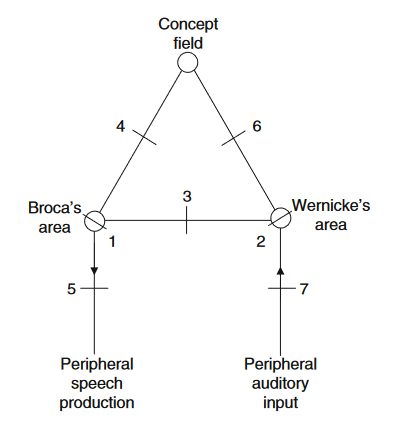
In the early 20th century, Ludwig Lichteim developed Wernicke’s model into the Broca-Wernicke-Lichteim model, also known as the Classic Model. The model contains three nodes: Broca’s area as the speech production centre, Wernicke’s area as the speech comprehension centre, and the neurally distributed “concept” centres for semantic representations [2, 5]. The classic model was essential in building our understanding of language in the brain. Nevertheless, it was still incomplete as it only focused on single words and did not explain how sentences were formed. It mainly relied on aphasiology and lacked computational components describing how the brain combined words and meanings into syntactic and semantic representations of phrases and sentences [4]. Thus, the classic model was insufficient in explaining how the brain enabled language in humans.
The Modern Neurolinguistic Models
In the 1950s, linguist Noam Chomsky developed generativism: a view in which language was seen as a computational system, a set of rule-based systems for generating sentences [3, 4]. Chomsky’s theory became one of the bases in the development of cognitive science: a new interdisciplinary study of the mind that linked areas such as linguistics, psychology, neuroscience, and philosophy. With the cognitive science perspective, researchers began to accommodate cognitively plausible linguistic and psycholinguistic theories that helped describe algorithms that the brain implements, to guide the discovery of the neural bases of language [3, 4]. Later in the ’70s, technological development also enabled new measures for studying the brain, such as using EEG to capture brain response after stimuli exposure. New neuroscientific methods allow researchers to observe the relationship between language and the brain in “real-time” in a living person. With new theories and methodologies, studies about language in the brain were then revolutionised [3, 4]. New models about how the brain enables language began to emerge. The following paragraphs will briefly highlight several of the most widely discussed modern models of language in the brain.
The Dual Stream Model by Gregory Hickok and David Poeppel
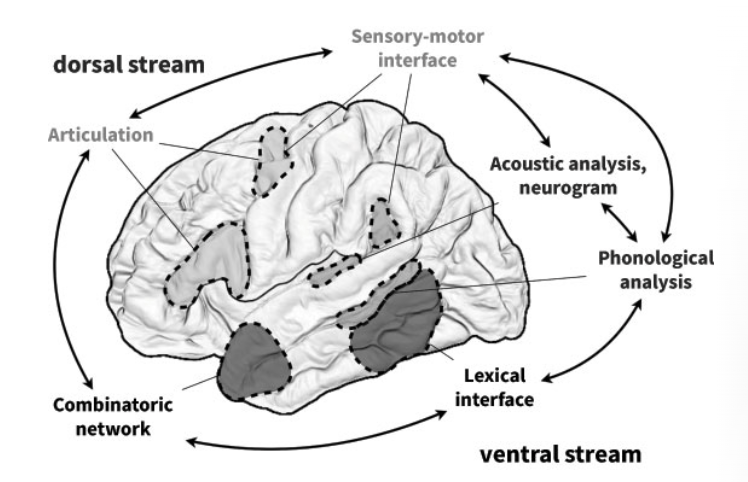
Modern neuroimaging studies provide evidence for the dual-stream model of language in the brain. The model describes two parallel speech information processing streams, the dorsal and ventral streams, each corresponding to a particular cortical network with a degree of functional autonomy [6]. The bilateral ventral stream, also known as the “what” stream, is responsible for understanding language; it processes speech inputs for comprehension. The ventral stream travels through the temporal and inferior frontal lobes, transforming information from acoustic sound to phonemes, lexical objects and finally, semantics. Meanwhile, the dorsal stream or the “how” stream supports speech production by connecting sound with articulatory motor systems. The dorsal stream is left lateralised and travels from superior temporal and parieto-temporal cortices to the left posterior inferior frontal cortex. The dual-stream model has proven helpful in explaining the need for the acoustic speech network to interact with both the concept and the motor-articulatory systems [3, 4].
The MUC Model by Peter Hagoort
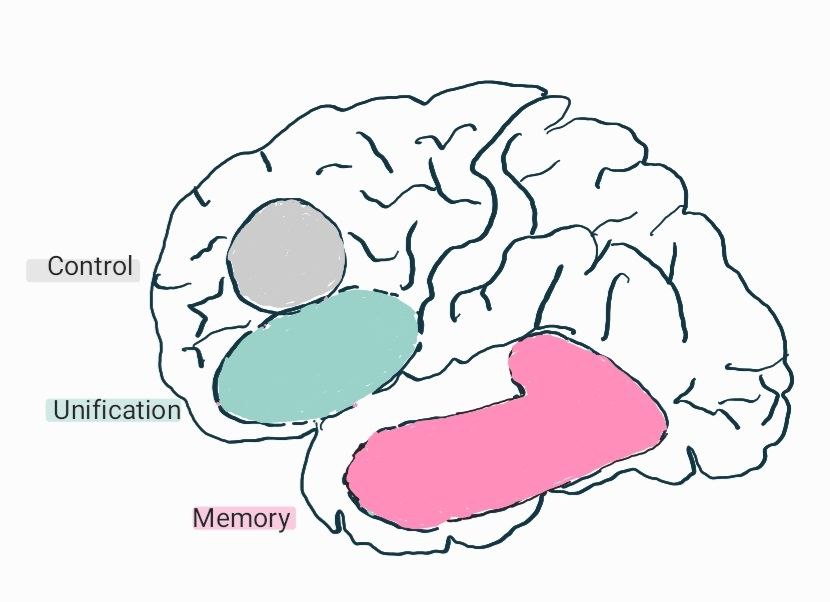
The MUC proposes a framework that unites psycholinguistic models and the neurobiological account of language. The model identifies three cortical components of the language system: a Memory component, a Unification component, and a Control Component. The Memory component contains phonological, syntactic and semantic representations of the building blocks of the language (morphemes, words, and construction) [7]. The location of the Memory component is in the left temporal lobe, especially in the middle and posterior regions. The Unification component serves as a workspace to put together the building blocks and is associated with the left inferior frontal gyrus. Meanwhile, the Control component oversees the collaboration between the Memory and Unification components. The control component is identified in the dorsolateral prefrontal cortex and the anterior cingulate cortex.
Language Model by Angela Friederici
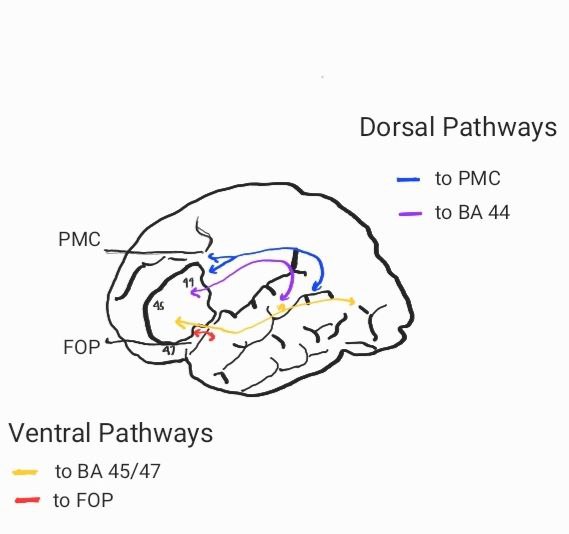
Friederici’s model extensively connects insights from linguistics, psycholinguistics, and neuroscience [10]. The model describes four main components of language in the brain: an acoustic-phonological processor, a left lateralised syntactic phrase structure building, a largely right hemispheric system for processing prosody, and an interpretation system for integrating information [8, 9, 10]. Friederici’s model closely inspects the syntactic building system as it argues that syntax is the core of human language capacity for its role in providing computational mechanisms that determine the relationship between words [9]. It also supports the syntax-first hypothesis, where a syntactic structure is formed before meaning. Moreover, the Merge concept, in which syntactic objects are combined to form a new structure, is emphasised.
Friederici argues that two dorsal and ventral pathways support language in the brain [8, 9, 10]. The first dorsal pathway is the auditory-to-motor mapping, connecting the premotor cortex (PMC) to the posterior superior temporal gyrus and sulcus (pSTG/STS). The second dorsal pathway is the key circuit for complex syntactic tasks, linking the pSTG/STS to the left inferior frontal gyrus (IFG, BA 44) via the white matter fibre arcuate fasciculus (AF). Meanwhile, semantic processing is associated with the first ventral pathway that connects the posterior temporal cortex to the anterior part of the IFG (BA 45/47). The second ventral pathway is claimed to support basic combinatorics when combining two syntax elements. It is associated with the uncinate fasciculus (UF) route connecting the anterior temporal lobe with the frontal operculum (FOP).
Concluding Remarks
The perspective from cognitive science has helped researchers develop new theories and methodologies, enabling the shift from the classical model to modern models of language in the brain [3, 4]. Our understanding of language in the brain has evolved from a strict localisation view to a more distributed view where a network of brain regions works collaboratively to perform language functions. Furthermore, recent studies have recognised that language is a complex multi-modal cognitive system that integrates information from multiple sources, thus, involving multiple brain regions [11]. Nevertheless, the dynamics and the margins of the language network are still under heavy investigation [11]. For instance, cognitive scientists are still actively debating the distinction between formal and functional linguistic competence, with evidence leading to the argument of language and thought as different systems [12, 13]. More studies are still needed to integrate the different levels of explanation and further our understanding of how the human brain enables language.
References
- Peebles, D., & Cooper, R. P. (2015). Thirty Years After Marr’s Vision: Levels of Analysis in Cognitive Science. Topics in Cognitive Science, 7(2), 187–190. https://doi.org/10.1111/tops.12137
- Levelt, W. (2012). A History of Psycholinguistics: The Pre-Chomskyan Era. Oxford University Press. https://doi.org/10.1093/acprof:oso/9780199653669.001.0001
- Baggio, G. (2022). Neurolinguistics. MIT Press.
- Brennan, J. R. (2022). Language and the Brain: A Slim Guide to Neurolinguistics. Oxford University Press.
- Hux, K. (2011). Wernicke–Lichtheim Model of Aphasia. In J. S. Kreutzer, J. DeLuca, & B. Caplan (Eds.), Encyclopedia of Clinical Neuropsychology (pp. 2702–2703). Springer. https://doi.org/10.1007/978-0-387-79948-3_935
- Hickok, G., & Poeppel, D. (2007). The cortical organisation of speech processing. Nature Reviews Neuroscience, 8(5), 393–402. https://doi.org/10.1038/nrn2113
- Hagoort, P. (2005). On Broca, brain, and binding: A new framework. Trends in Cognitive Sciences, 9(9), 416–423. https://doi.org/10.1016/j.tics.2005.07.004
- Friederici, A. D. (2011). The Brain Basis of Language Processing: From Structure to Function. Physiological Reviews, 91(4), 1357–1392. https://doi.org/10.1152/physrev.00006.2011
- Friederici, A. D. (2017). Language in Our Brain: The Origins of a Uniquely Human Capacity. The MIT Press. https://directory.doabooks.org/handle/20.500.12854/78546
- Morgan, E., & Baggio, G. (2019). Language in Our Brain: The Origins of a Uniquely Human Capacity, by Angela D. Friederici. Journal of Language Evolution, 4(1), 78–81. https://doi.org/10.1093/jole/lzy009
- Hertrich, I., Dietrich, S., & Ackermann, H. (2020). The Margins of the Language Network in the Brain. Frontiers in Communication, 5, 519955. https://doi.org/10.3389/fcomm.2020.519955
- Fedorenko, E., & Varley, R. (2016). Language and thought are not the same thing: Evidence from neuroimaging and neurological patients: Language versus thought. Annals of the New York Academy of Sciences, 1369(1), 132–153. https://doi.org/10.1111/nyas.13046
- Mahowald, K., Ivanova, A. A., Blank, I. A., Kanwisher, N., Tenenbaum, J. B., & Fedorenko, E. (2023). Dissociating language and thought in large language models: A cognitive perspective (arXiv:2301.06627). arXiv. http://arxiv.org/abs/2301.06627
(aliva.sholihat@helsinki.fi)
 livalearning