
(aliva.sholihat@helsinki.fi)

In October 2019, a Wall Street Journal report on a pioneering project at a Chinese public elementary school captured global attention. This project involved the use of consumer-grade EEG (electroencephalogram) headbands to monitor students’ brain activity during classroom lessons, aiming to glean insights into their attentional states. This was visually represented by a spectrum of coloured lights within an app, accessible to teachers. Sparking worldwide debate among educators and parents, this report raised critical questions about the pros and cons of such technology in educational contexts. Furthermore, numerous experiments have explored the use of EEG wearables in education, notably for neurofeedback to improve student concentration and attention (Janssen & van Atteveldt, 2022; Williamson, 2019). Today, the application of neurotechnology in education, particularly with children’s developing brains, remains an area of unresolved ethical dilemmas.
This particular episode resurfaced recently as I developed my PhD research plan in cognitive science at the Department of Digital Humanities. While my current research diverges from my previous master’s focus on educational science, its potential implications in education continue to shape my outlook. Employing neurotechnology as my primary method necessitates a careful and broad ethical consideration that extends beyond my own discipline.
From passive brain imaging to active brain stimulation method
Currently, passive brain imaging technologies like EEG are widely used in brain research, with a growing interest in active brain stimulation methods. Today’s tools are not only capable of ‘reading’ the brain but also ‘writing’ into it, employing non-invasive brain stimulation (NIBS) techniques like transcranial magnetic stimulation (tMS) and transcranial electrical stimulation (tES) to modify neuronal activity (Bhattacharya et al., 2022). As a researcher utilising one of these methods, I often ponder the broader ramifications of my work. Although my primary focus is basic cognitive neuroscience research, the prospect of these devices’ application in different domains demands consideration of their wider impact.
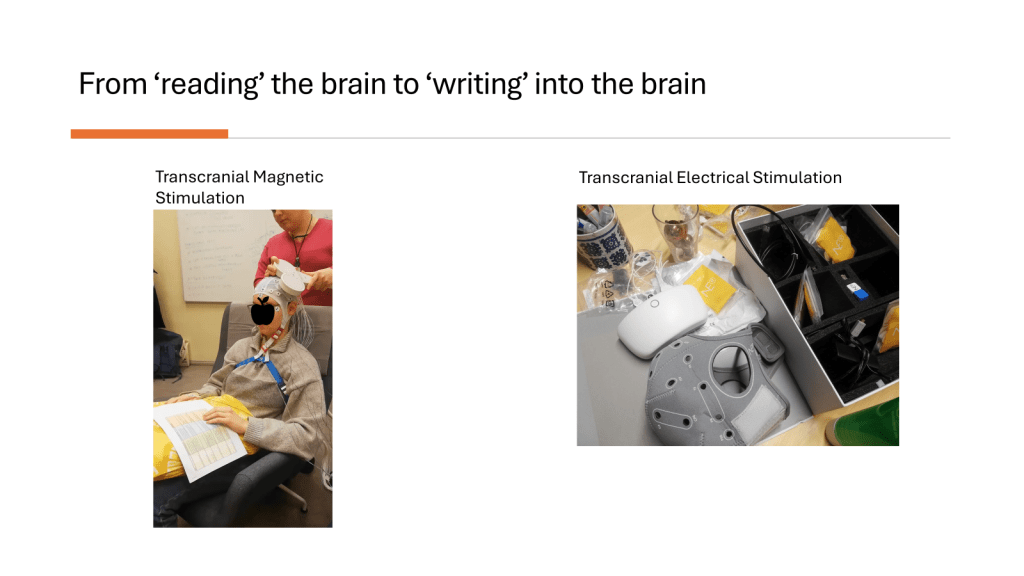
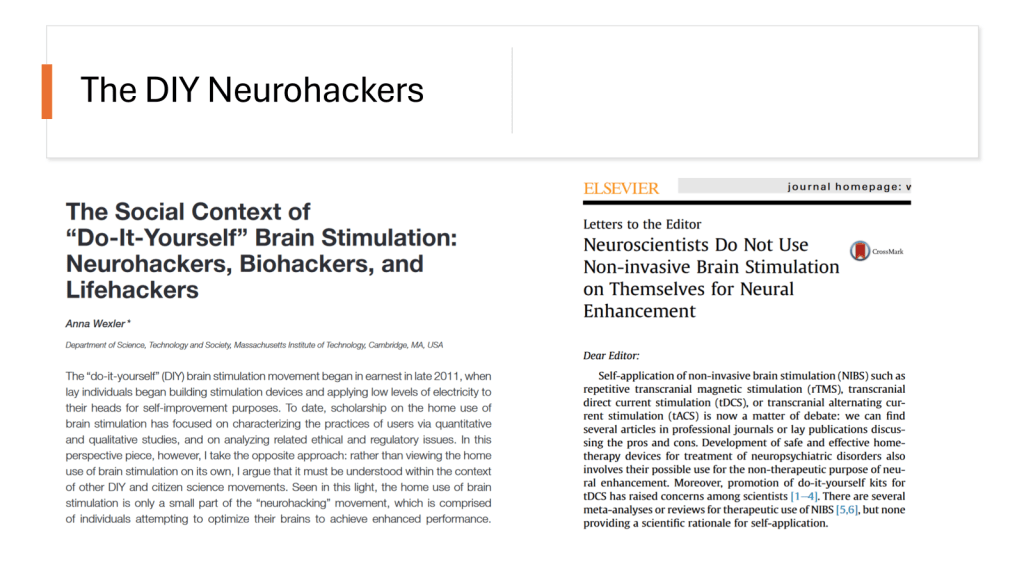
One of the most intriguing examples is how NIBS quickly transformed into wearable consumer products. Brain stimulation wellness devices claiming cognitive enhancement benefits are already entering the market. An example is the consumer tDCS (transcranial direct current stimulation) device, a type of tES, that has gained popularity among biohackers and in complementary and alternative medicine (CAM) practices, despite lacking FDA clearance and scientific consensus on its efficacy (Wexler, 2017). The potential repercussions of this trend, especially its possible foray into education, present numerous ethical considerations.
In the context of cognitive neuroscience research, the state of the NIBS method is developing quite significantly, especially with the rapid advancement of machine learning techniques. One example is the development of a closed-loop system where the stimulation is automatically adjusted based on real-time activity (Ketz et al., 2018). This system constantly monitors specific neural markers and attunes the stimulation parameters accordingly. It is a more dynamic approach compared to traditional fixed stimulation methods, allowing for potentially more effective stimulation. Nevertheless, such an automatic system begs the question of who is actually in control of the stimulation (Hendriks et al., 2019). If the algorithm runs the system, what is the role of the researcher here, and how exactly can we ensure the safety of our participants? With more advanced methods coming into play, more ethical dilemmas may often follow.
The ethics of neurotechnology in human studies
My research looks into the concept of ‘offline brain power’ or ‘offline processing.’ It focuses on the phase after learning has occurred, a critical time for memory consolidation. This process primarily happens during sleep, a period of rest when the brain organises and solidifies newly acquired information (Rasch & Born, 2013). My emphasis lies on statistical language learning – a foundational process whereby humans discern patterns and regularities from linguistic exposure (Romberg & Saffran, 2010; Saffran et al., 1996). I investigate the memory consolidation of this type of learning, particularly during sleep. In one of my planned studies, I will employ one type of tES method called transcranial alternating current stimulation (tACS). The tACS device is used to stimulate slow frequency oscillations in the deep sleep stage, examining its potential causal effects on enhancing statistical language learning performance.
At this stage, we are examining various ethical issues relevant to my research. My project involves two distinct labs: the Cognitive Architecture of Language Learning Lab in the Department of Digital Humanities at the Faculty of Arts, and the Sleep and Mind Lab at the Department of Psychology in the Faculty of Medicine. Due to its interdisciplinary nature, the ethical dimension becomes even more complex. Nevertheless, the safety of our research participants is paramount. Thus, all of my PhD supervisors, which also include the principal investigators of both labs, are actively involved in the ethical discussions.
One key topic that we are currently discussing is the justification for using NIBS to address our research questions. While the tACS method is generally considered safe in research settings, and its effects are mainly transient, there’s limited comprehensive data on its stimulation effects across different sleep stages (Antal et al., 2017). The primary concern is the possible zero-sum nature of cognitive neuroenhancement, suggesting potential unknown costs (Brem et al., 2014). Since sleep is homeostatically regulated, the impact of augmenting slow-wave oscillations (SWOs) during daytime naps on overnight sleep architecture is not fully understood (Pigeon & Perlis, 2006). For example, such stimulation during daytime nap lab experiments might decrease overnight REM sleep, possibly leading to negative mood effects in participants the next day. Although this scenario is unlikely, it cannot be entirely ruled out. How then can we reconcile these risks, given the limited literature available?
Furthermore, we must consider our research’s broader implications. While aiming to identify a causal mechanism beyond mere correlation in basic cognitive neuroscience—the role of slow oscillations in memory consolidation of statistical language learning—we must also consider how positive findings might be misused in practical applications. There is a risk that companies of consumer wearable tES devices might claim, citing our findings, that their products enhance learning capabilities, including language learning. Currently, consumer brain stimulation devices are marketed with claims of improving attention, memory, and learning, highlighting the necessity for careful interpretation and application of our research in this field.
Utilising reflexive tools for neuroethics
Currently, I am exploring whether I could find a specific tool for guiding our ethical discussions. Such a tool would be beneficial in providing a structured approach to these discussions. Given the complexity and potential ambiguity of ethical topics, a framework to systematically guide our conversation is essential to prevent us from veering into uncharted territories.
For example, the University of Washington’s Center of Neurotechnology has developed the Scientific Perspectives and Ethics Commitments Survey (SPECS) to assist in such a process (Tubig & McCusker, 2021). The SPECS process involves three key steps: First, researchers complete an ethical survey consisting of various prompts related to the use of neurotechnology in human studies. This is followed by a facilitated dialogue, where participants discuss their responses and the reasoning behind them. Finally, after the discussion, participants revisit the survey prompts to assess if their initial responses have changed. This reflective process helps in deepening the understanding of ethical considerations in research.
SPECS, as a methodology, stimulates critical thinking and inquiry into the conceptual aspect of a research project (Tubig & McCusker, 2021). It stems from the idea of ethical reflexivity. Ethical reflexivity involves a reflective activity where researchers articulate, analyse, and assess the values and assumptions underlying their ethical actions. It’s a transformative activity that engages researchers’ moral competence, ensuring they remain responsive to diverse public needs and ethical concerns. This process is vital for fostering trustworthiness in researchers and institutions, ensuring that the development and application of neurotechnologies are guided by ethics and goodwill.
The need for interdisciplinary discussions
Another important aspect of my PhD project is its organisational arrangement; it is situated under the CLIC (Cognition, Learning, Instruction, and Communication) Doctoral School, which technically is within the Faculty of Education. This highlights the necessity of involving educational experts in the ethical considerations of my research. Often, the education sector seems to be playing catch-up with technological advancements. For example, we were unprepared for the sudden shift to distance learning during the pandemic. Similarly, the emergence of artificial intelligence technologies like chatGPT, and the potential applications of neurotech, including brain-computer interfaces (BCI) and the ideas associated with transhumanism, present new challenges. Preparing ourselves for the possible merging of AI and neurotech in education is a complex task.
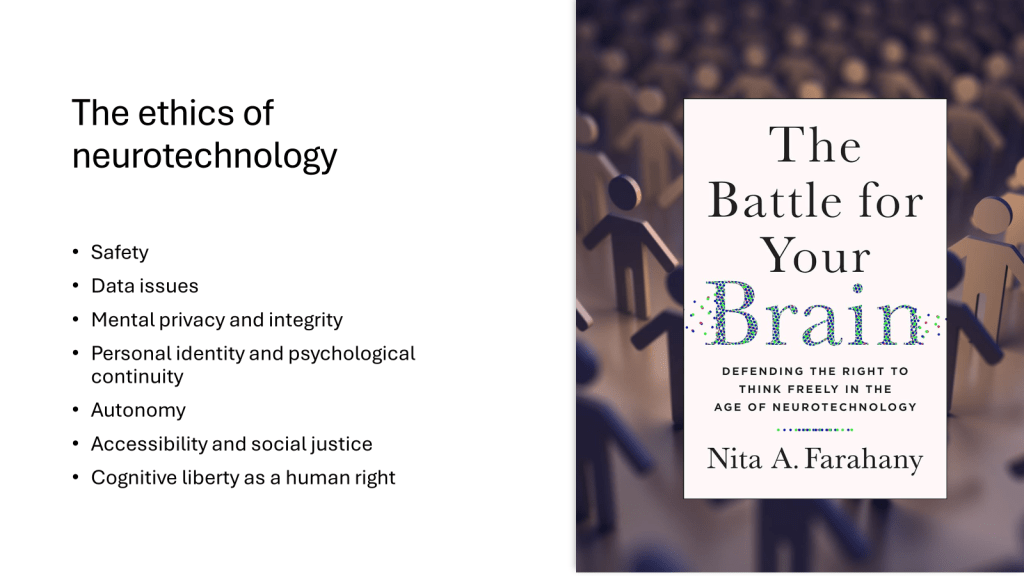
Addressing key ethical issues is essential, such as the safety of these technologies on developing brains, questions of agency – particularly when the use of technology is not the child’s decision but is driven by others, like ambitious parents seeking to enhance their child’s learning – and issues of equality, where access to neurotech could increase educational achievement disparities (Eaton, 2023; Privitera & Du, 2022).
I realise that there are many questions we still need to address. This brief reflection serves merely as a starting point for more necessary discussions. I view this writing process as an exercise in practising ethical reflexivity, as exemplified by the SPECS framework discussed above. Moving forward, fostering an interdisciplinary dialogue that includes engineers, clinicians, neuroscientists, and educational experts is crucial. Such collaboration is essential for effectively navigating the emerging ethical landscapes in this field.
References
Antal, A., Alekseichuk, I., Bikson, M., Brockmöller, J., Brunoni, A. R., Chen, R., Cohen, L. G., Dowthwaite, G., Ellrich, J., Flöel, A., Fregni, F., George, M. S., Hamilton, R., Haueisen, J., Herrmann, C. S., Hummel, F. C., Lefaucheur, J. P., Liebetanz, D., Loo, C. K., Paulus, W. (2017). Low intensity transcranial electric stimulation: Safety, ethical, legal regulatory and application guidelines. Clinical Neurophysiology, 128(9), 1774–1809. https://doi.org/10.1016/j.clinph.2017.06.001
Bhattacharya, A., Mrudula, K., Sreepada, S. S., Sathyaprabha, T. N., Pal, P. K., Chen, R., & Udupa, K. (2022). An Overview of Noninvasive Brain Stimulation: Basic Principles and Clinical Applications. Canadian Journal of Neurological Sciences, 49(4), 479–492. https://doi.org/10.1017/cjn.2021.158
Brem, A.-K., Fried, P. J., Horvath, J. C., Robertson, E. M., & Pascual-Leone, A. (2014). Is neuroenhancement by noninvasive brain stimulation a net zero-sum proposition? NeuroImage, 85, 1058–1068. https://doi.org/10.1016/j.neuroimage.2013.07.038
Eaton, S. E. (2023). Postplagiarism: Transdisciplinary ethics and integrity in the age of artificial intelligence and neurotechnology. International Journal for Educational Integrity, 19(1), 23. https://doi.org/10.1007/s40979-023-00144-1
Hendriks, S., Grady, C., Ramos, K. M., Chiong, W., Fins, J. J., Ford, P., Goering, S., Greely, H. T., Hutchison, K., Kelly, M. L., Kim, S. Y. H., Klein, E., Lisanby, S. H., Mayberg, H., Maslen, H., Miller, F. G., Rommelfanger, K., Sheth, S. A., & Wexler, A. (2019). Ethical Challenges of Risk, Informed Consent, and Posttrial Responsibilities in Human Research With Neural Devices: A Review. JAMA Neurology, 76(12), 1506. https://doi.org/10.1001/jamaneurol.2019.3523
Janssen, T. W. P., & van Atteveldt, N. (2022). Explore your brain: A randomized controlled trial into the effectiveness of a growth mindset intervention with psychosocial and psychophysiological components. British Journal of Educational Psychology, n/a(n/a). https://doi.org/10.1111/bjep.12572
Ketz, N., Jones, A. P., Bryant, N. B., Clark, V. P., & Pilly, P. K. (2018). Closed-Loop Slow-Wave tACS Improves Sleep-Dependent Long-Term Memory Generalization by Modulating Endogenous Oscillations. The Journal of Neuroscience, 38(33), 7314–7326. https://doi.org/10.1523/JNEUROSCI.0273-18.2018
Pigeon, W. R., & Perlis, M. L. (2006). Sleep homeostasis in primary insomnia. Sleep Medicine Reviews, 10(4), 247–254. https://doi.org/10.1016/j.smrv.2005.09.002
Privitera, A. J., & Du, H. (2022). Educational neurotechnology: Where do we go from here? Trends in Neuroscience and Education, 29, 100195. https://doi.org/10.1016/j.tine.2022.100195
Rasch, B., & Born, J. (2013, April). About Sleep’s Role in Memory. https://doi.org/10.1152/physrev.00032.2012
Romberg, A. R., & Saffran, J. R. (2010). Statistical learning and language acquisition. Wiley Interdisciplinary Reviews. Cognitive Science, 1(6), 906–914. https://doi.org/10.1002/wcs.78
Saffran, J. R., Aslin, R. N., & Newport, E. L. (1996). Statistical Learning by 8-Month-Old Infants. Science, 274(5294), 1926–1928. https://doi.org/10.1126/science.274.5294.1926
Tubig, P., & McCusker, D. (2021). Fostering the trustworthiness of researchers: SPECS and the role of ethical reflexivity in novel neurotechnology research. Research Ethics, 17(2), 143–161. https://doi.org/10.1177/1747016120952500
Wexler, A. (2017). The Social Context of “Do-It-Yourself” Brain Stimulation: Neurohackers, Biohackers, and Lifehackers. Frontiers in Human Neuroscience, 11. https://doi.org/10.3389/fnhum.2017.00224
Williamson, B. (2019). Brain Data: Scanning, Scraping and Sculpting the Plastic Learning Brain Through Neurotechnology. Postdigital Science and Education, 1(1), 65–86. https://doi.org/10.1007/s42438-018-0008-5
 livalearning