
(aliva.sholihat@helsinki.fi)
Language has always fascinated me. I was brought up in a country brimming with linguistic diversity, a vibrant melting pot of roughly 10% of the world’s languages. Our easternmost neighbour, Papua New Guinea, boasts the highest linguistic diversity on the planet, while Indonesia comes second [1]. Given its ubiquitous nature, humans often overlook language, rarely giving it a second thought until we find ourselves in a situation where the language is alien to us, perhaps during overseas travel. However, I did not have to set foot outside my home country to experience this sensation of being ‘lost in translation’. Even though we have a national language widely spoken by many, it is common to hear groups of people conversing in their ethnic languages, sounding unintelligible to me. This daily occurrence made me wonder. How do these diverse groups of people speak different languages? How did these linguistic variations originate? And perhaps the most intriguing question that nagged me as a child: what was the very first language spoken by humans on Earth?
This enduring curiosity in language is probably what steered me towards cognitive science. The interdisciplinary nature of cognitive science aligns well with my rather mixed academic background. Despite my interest in language, I had never formally studied linguistics—I started as an engineering student. My basic knowledge about language primarily stems from popular science books, such as The Language Instinct by Steven Pinker [2]. His effective style of communicating science has made him a recognisable figure in topics like the mind and language.
However, after studying cognitive science for almost two years now, I have found myself taken aback by how outdated Pinker’s perspectives are on many fronts. Had I not been exposed to academic discussions in the field, I would not have been informed about the current development in our understanding of human cognition. Consequently, I have now become a fervent advocate for the public to regularly update their popular science book references. On the topic of language, I could not recommend this book enough—The Language Game: How Improvisation Created Language and Changed the World, written by two prominent cognitive scientists, Morten H. Christiansen and Nick Chater [3].
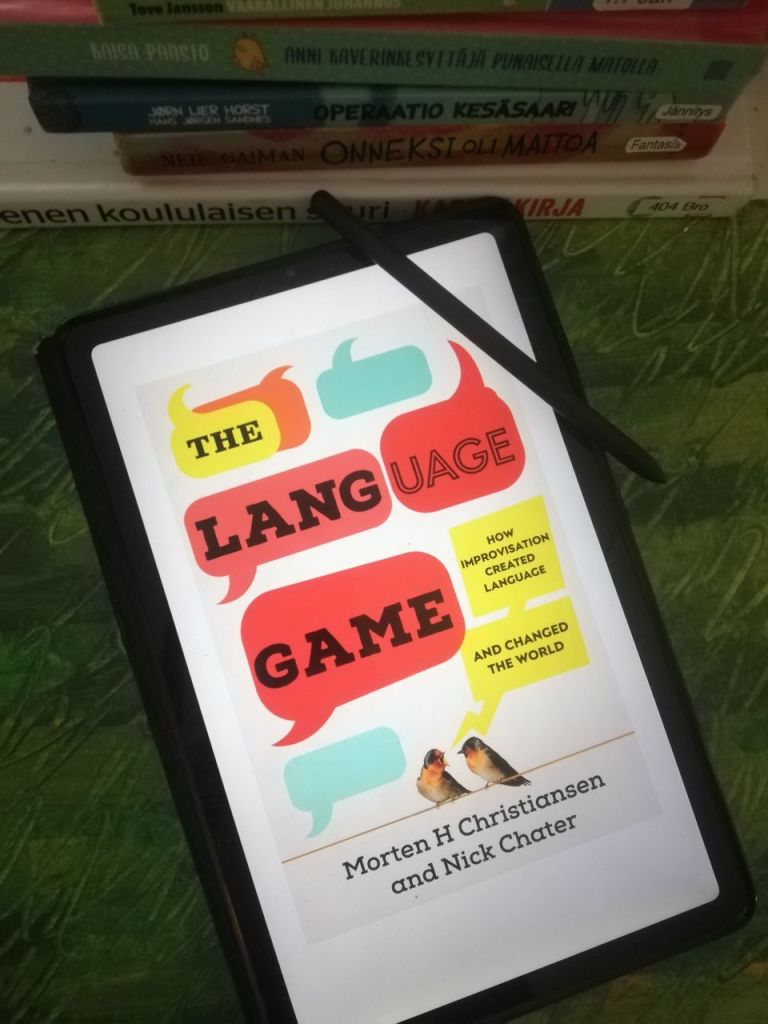
The Language Game is quite an ambitious book, covering a wide range of topics related to language. Starting from the philosophical discussion on the nature of language, the evolution of language, language acquisition and learning, linguistic diversity, language in the brain, to the contemporary debate on language in the era of ChatGPT. The book’s main argument is inspired by Wittgenstein’s concept of “Sprachspiel” or “language games.” Building on this idea, the authors create a metaphor likening language to a game of charades.
Contrary to the paradigm which views language as a structured and orderly entity, the book argues that ‘messiness,’ the social and cultural factors form the core of language. Engaging with language is equated to participating in a game of charades, with improvisation, creativity, and spontaneity being crucial for communication. This metaphor serves to underline the idea that language is a form of life. The usage and meanings of words heavily depend on their context. “The unbearable lightness of meaning,” a clever adaptation from Milan Kundera’s novel, is used by the authors to illustrate the inherent flexibility and adaptability of language.
The book offers many stimulating discussions that can easily connect with my cognitive science courses. My favourite part of the book is the chapter that explores language evolution. Christiansen and Chater seem to agree with The New Thinking paradigm from Cecilia Heyes, moving away from the High-Church evolutionary psychology advocated by Pinker [4]. The New Thinking paradigm emphasises a nuanced understanding of the interplay between genetic, environmental, and cultural aspects in cognitive evolution [4]. Instead of being a product of genetic instincts, human cognition, including language, is argued to be developed through social and cultural learning. Rather than possessing a specific, hardwired language module, the human brain employs a “neuronal recycling” mechanism to create “new parts from the old” based on its cognitive niche [5]. Given the book’s emphasis on cultural learning and transmission, I suppose the authors would agree with Laland’s idea that language originally evolved to teach one’s kin [6].
Furthermore, the authors seem eager to challenge Chomsky’s nativist search for a language gene. Recent findings about FOXP2, the gene often linked to language skills, suggest that it supports a domain-general mechanism vital for various aspects of human perception and cognition, not language per se [3]. Individuals with a FOXP2 disorder exhibit deficiencies in sequence learning. This disruption affects multiple modalities, extending beyond auditory learning. The authors argue what enables the human brain to produce language is not specifically linguistic in nature: “language evolved by piggybacking on pre-existing mechanisms for learning, memory and socio-communicative interaction” [3]. It appears that the authors aim to distance themselves from genetic determinism, advocating instead for a more flexible, learned nature of human cognition.
The book can serve as your go-to guide for obtaining a comprehensive overview of the science of language. Nonetheless, it falls short of my expectations in a couple of aspects. First, while it predominantly focuses on sociolinguistics, the book does not allocate sufficient space to delve into the neurobiology of language. The authors do not provide an adequate explanation regarding the neural processes involved in playing the game of charades. How does this activity manifest within one’s brain? To me, it seems plausible to establish a connection between the metaphor of charades and the concept of “brain-to-brain coupling,” as explored in studies investigating speech comprehension and production within naturalistic contexts [7, 8]. To quote Giacomo Novembre, an Italian neuroscientist who frequently employs the hyper-scanning method in his research, “brains that work together couple together through inter-brain synchrony.” However, such a discussion is nearly absent from the book.
Secondly, since Christiansen is a prominent figure in the domain of statistical language learning, you might expect to encounter a substantial discussion on the computational approach to language. The authors extensively discuss Chomsky’s generative grammar and primarily argue against his notion that this mechanism arises from an innate universal grammar. However, they do not explore other computational linguistic approaches beyond Chomsky’s, giving the impression that the field is no longer relevant for discussion. This is understandable since they intend to promote the idea that language is akin to a spontaneous game of charades, rather than something that can be easily modelled by mathematics. Nonetheless, in doing so, the authors may miss the opportunity to enhance the persuasiveness of the final chapter of their book—”Language Will Save Us from the Singularity.”
The epilogue explores the reasons why current AI fails to match human linguistic abilities. The authors boldly assert that machines are incapable of playing the game of charades, lacking the essential elements of human linguistic ingenuity. However, the authors neglect to provide sufficient backstory regarding the intertwined development of artificial neural networks in AI and the implementation of connectionist models in studying language [9]. Despite their limitations, the empirical success of Large Language Models in generating coherent and accurate sentences offers evidence supporting the validity of the computational approach to language.
The chapter briefly explains that language models operate by learning statistical patterns within language, bypassing the need for understanding meaning. Employing an iceberg metaphor, the authors argue that current language models merely touch the surface of the iceberg, while humans, capable of playing the game of charades, have access to its entirety. However, I believe the authors could make a stronger point by discussing the plausibility of statistical learning as a shared mechanism between humans and machines—a hypothesis proposed by Christiansen himself in his latest published article [10]. From there, the authors can expand on the limitations of statistical learning, elucidating why AI still falls short in numerous aspects.
Moreover, I find it helpful to connect the final chapter of the book with the notion of disassociating language and thought, as suggested by a recent article from Ev Fedorenko’s lab [11]. The article advocates for distinguishing between formal competence and functional competence in language. I assume that playing the language game, as Christiansen and Chater put it, necessitates both formal and functional competences. Machines excel in formal competence, touching the tip of the iceberg. However, they still lag in functional competence—the submerged part of the iceberg. Consequently, it becomes apparent to me that playing the language game demands moving beyond statistical learning. Common sense, world understanding, embodiment, social and cultural contexts, agency, emotions, theory of mind—all these elements cannot be fully explained through statistics.

Despite the criticisms I have raised, I firmly believe that the book remains a complete package. Attempting to encapsulate the vastness of scientific exploration into human language within a single book is an impossible feat. Nonetheless, the book admirably provides a panoramic view that captures the fundamental elements of language. It introduces a catchy metaphor, the “game of charades,” which weaves its way as a recurring theme throughout its pages. It presents compelling arguments that pique your curiosity and urge you to go deeper into the latest research. All in all, I would confidently rate it a nine out of ten and recommend adding it to your must-read list.
References
- Indonesia | Ethnologue Free. Retrieved 30 May 2023, from https://www.ethnologue.com/country/ID/
- Pinker, S. (1994). The language instinct: The new science of language and mind. Allen Lane. https://play.google.com/store/books/details/The_Language_Instinct_How_The_Mind_Creates_Languag?id=l7dryHvwDiMC&hl=en_US&gl=US
- Christiansen, M. H., & Chater, N. (2022). The Language Game: How improvisation created language and changed the world. Random House. https://books.google.fi/books/about/The_Language_Game.html?id=mgJtzgEACAAJ&redir_esc=y
- Heyes, C. M. (2018). Cognitive gadgets: The cultural evolution of thinking. The Belknap Press of Harvard University Press. https://books.google.fi/books/about/Cognitive_Gadgets.html?id=lbpTDwAAQBAJ&redir_esc=y
- Dehaene, S., & Cohen, L. (2007). Cultural Recycling of Cortical Maps. Neuron, 56(2), 384–398. https://doi.org/10.1016/j.neuron.2007.10.004
- Laland, K. N. (2017). The origins of language in teaching. Psychonomic Bulletin & Review, 24(1), 225–231. https://doi.org/10.3758/s13423-016-1077-7
- Hasson, U., Ghazanfar, A. A., Galantucci, B., Garrod, S., & Keysers, C. (2012). Brain-to-brain coupling: A mechanism for creating and sharing a social world. Trends in Cognitive Sciences, 16(2), 114–121. https://doi.org/10.1016/j.tics.2011.12.007
- Silbert, L. J., Honey, C. J., Simony, E., Poeppel, D., & Hasson, U. (2014). Coupled neural systems underlie the production and comprehension of naturalistic narrative speech. Proceedings of the National Academy of Sciences, 111(43), E4687–E4696. https://doi.org/10.1073/pnas.1323812111
- Joanisse, M. F., & McClelland, J. L. (2015). Connectionist perspectives on language learning, representation and processing. WIREs Cognitive Science, 6(3), 235–247. https://doi.org/10.1002/wcs.1340
- Contreras Kallens, P., Kristensen‐McLachlan, R. D., & Christiansen, M. H. (2023). Large Language Models Demonstrate the Potential of Statistical Learning in Language. Cognitive Science, 47(3), e13256. https://doi.org/10.1111/cogs.13256
- Mahowald, K., Ivanova, A. A., Blank, I. A., Kanwisher, N., Tenenbaum, J. B., & Fedorenko, E. (2023). Dissociating language and thought in large language models: A cognitive perspective. http://arxiv.org/abs/2301.06627
 livalearning