
(Helsinki, May 2021)
I remember it was dark and cold November, typical for Arctic winter months. I had an early morning class, 8.15. And of course, I came 10 minutes late to the class, typically me.
Little did I know that the class wasn’t going to be a typical class. It’s probably one of the most heart wrenching, eye-opening lectures in my whole entire history of EdGlo classes.
That day we had Elisa Pascucci from Helsinki University presenting her stances on Mobility, Borders and The Refugee Regime.
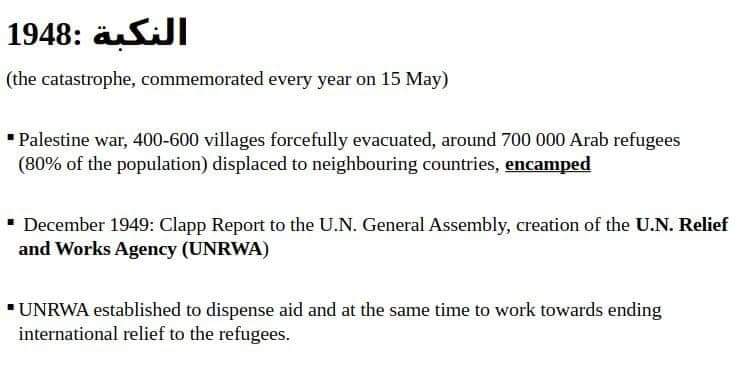
In the backdrop of the current crisis in Palestine, my mind can’t help but wander back to that exact early morning lecture in Northern Ostrobothnia. Yesterday, 15 May, was the commemoration of Nakbah Day 1948 (the day of catastrophe).
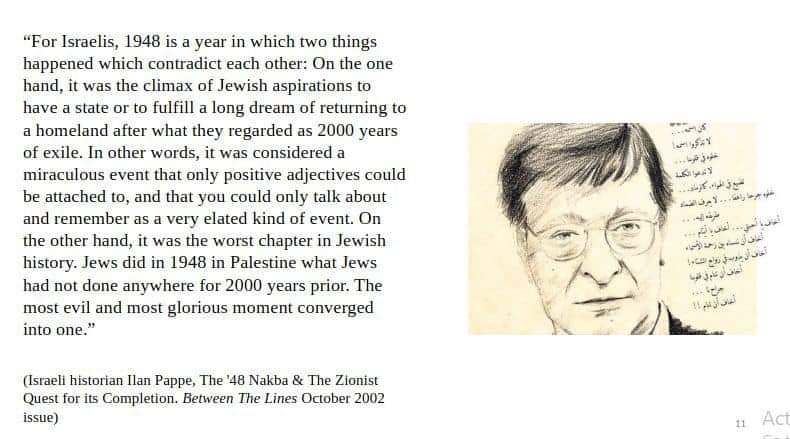
Here’s a snippet into her slides where she quoted Ilan Pappe, a very critical Israeli historian. She also mentioned Edward Said many times, so by now, you could probably have guessed what kind of stance she took regarding the Palestinian crisis.
I was, in fact, quite struck that such a critical, sincere and raw discussion on Palestine (or displacement in general) could be openly presented in a Western academia. Honestly, at least a hint of intellectual hypocrisy was what I expected.
But the lecture opened my eyes…
The West isn’t monolithic. It isn’t fair to paint someone nor a country with the same broad brush of “the West.” Finland is not the US, not the UK, or what have you. Each Western culture has its own distinct features and flavour.
We also need to be critical that it is not particularly helpful to have this artificial binary opposition between the Occident and the Orient. The construction of “the other” is a dangerous path to take. History has shown us that it can lead us to so many unimaginably horrific places.
Taking a critical stance on the Zionist regime is not equal to anti-semitism. In many places of the world, it’s becoming more and more mainstream to be vocal on the Palestinian crisis. Racism, oppression, apartheid, genocide, colonialism. Yes, you can mention all of those strong facts unapologetically.
Or at least, this is what I learned from one university so far-flung in the North, here in Finland.
You may have completely different experiences, different stories. But this is mine.
By definition, each personal narrative is a valid story to tell. So if you disagree with what I’m saying here, write down your own. I’ll be all ears.
*Here’s a link to what Noam Chomsky & Ilan Pappe have to say on Palestine:
https://drive.google.com/file/d/1EcM2chGCFezNMORPPKmPx-tlaaH3Lj23/view
 livalearning