
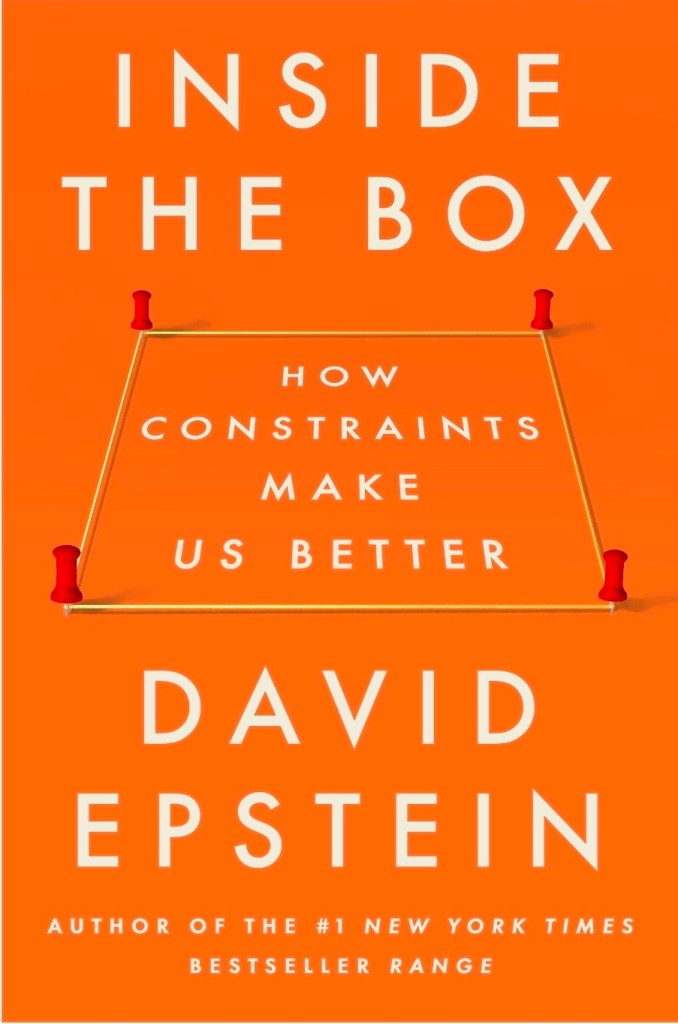
This weekend I’m reading David Epstein’s new book. Epstein is the author of Range, that bestselling book about generalists. Interestingly, this time he writes about almost the opposite of “breadth.” His latest book is about constraints and how they support creativity. I think he’s a big fan of that famous optimal U-shaped curve in performance science, trying to find the Goldilocks zone between opposing things like stress and calm states. So the move from freedom to restraint feels almost symbolic here: he’s trying to find the optimal zone.
However, somehow, while reading it, I kept thinking back to Cognitive Science Days, an event I attended just last Thursday and Friday, organized by the Finnish Cognitive Science Society.
https://blogs.helsinki.fi/cognitive-science/cogsci-days-4-5-june-2026/
I also got to present my own work there, but what stayed with me afterward were two talks in particular: Prof. Pertti Saariluoma’s point about relevance, and Prof. Tuomo Kujala’s talk about bounded rationality.
At first, they felt like separate things. Epstein was writing about creativity. Saariluoma was talking about relevance. Kujala was talking about our cognitive bounds. And my own work was about statistical language learning and bodily regulation.
But slowly, they started to form one common thread. And that is actually what this post is about. It is not exactly a book review.
The first idea came from Saariluoma’s slide. His point, as I understood it, was about relevance. Saariluoma is one of the pioneers of cognitive science in Finland, so it makes sense that he returned to one of the classic problems in the field: the frame problem, or more broadly, the relevance problem. It is basically the question of how an intelligent system knows what matters in a situation, what should be updated, and what can be safely ignored.
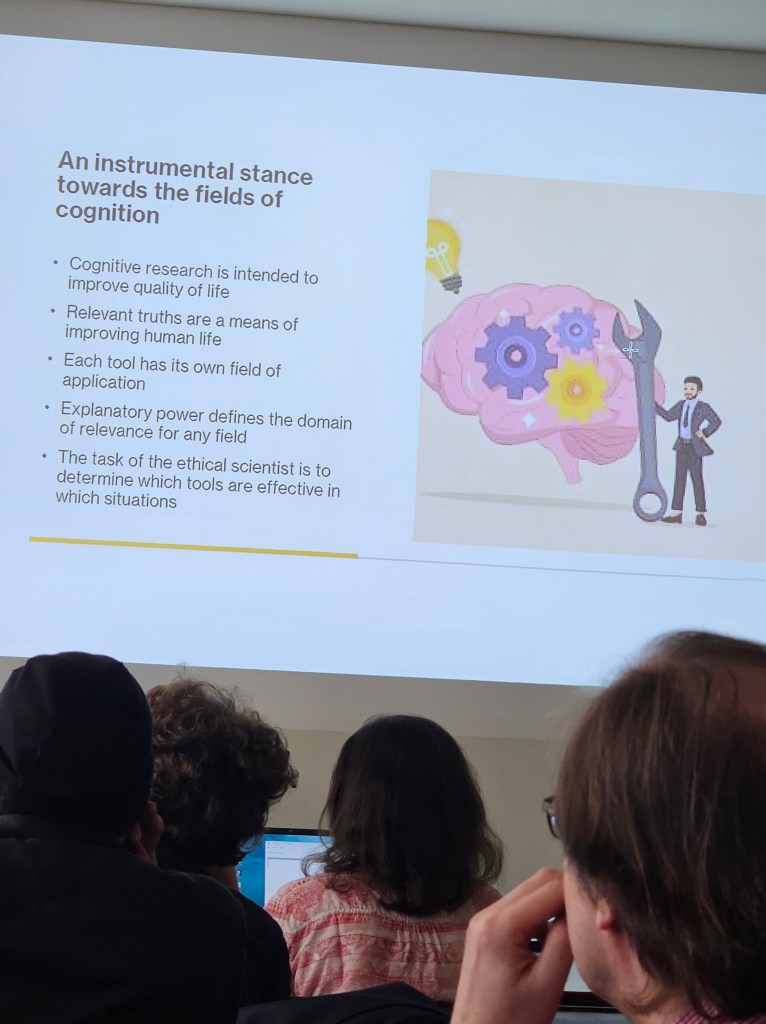
Before we can solve a problem, the problem has to be formulated first. Before we choose a method, we need to know what matters. Mathematics can be very powerful once the problem is already defined. But mathematics cannot, by itself, decide which problem is worth solving, which variable is relevant, which level of explanation is appropriate, or which tool should be used in which situation.
And I think this becomes even more obvious in today’s age of AI.
AI needs a prompt. A neural network needs engineers to define the architecture, parameters, training data, loss function, and constraints. The machine can optimize within a frame, but the frame itself has to be given. Someone has to decide what counts as relevant.
So the deeply human task is not only solving problems. It is deciding which problem matters in the first place.
Then came Tuomo Kujala’s talk about bounded rationality. Bounded rationality, the idea famously associated with Nobel laureate Herbert Simon, basically says that humans do not make decisions like perfect optimizing machines.

We have limited time, limited information, limited attention, and limited cognitive capacity. So instead of finding the absolute best option from all possible alternatives, we often choose something that is good enough. Instead of maximizing, we satisfice. We have biases, we use heuristics to make decisions, and we are not fully rational.
Kujala ended with a sentence that really stayed with me: our bounds are our superpower.
The argument is not simply that humans are biased and therefore imperfect. It is more interesting than that. Our cognitive bounds are also what allow us to act in the world at all.
Because if we really had to consider everything, we would never act. If we had to optimize every decision, we would be paralyzed. If we had to process every possible detail in the environment, we would drown in information.
So our bounds force us to choose. They force us to ignore. They force us to ask: what matters here?
And this is where Kujala’s point connects back to Saariluoma’s relevance problem. Relevance becomes important exactly because we are bounded. If we cannot consider everything, then we need to determine what is relevant. If we cannot search the whole space, then we need a frame.
This is also where my own research suddenly entered the picture.
My work is on statistical language learning, basically how humans pick up probabilistic patterns from speech. It is often studied as an implicit mechanism. The brain absorbs regularities from the environment without explicit instruction. Certain syllables go together. Certain sound patterns repeat. Slowly, the stream becomes structured. The world becomes more predictable.
And from the perspective of bounded rationality, this makes sense. A bounded brain cannot process every moment as completely new. It needs to learn the regularities of the environment. Once the environment is familiar, you do not need to scan everything again from scratch. You get the gist. You know what usually happens. You know what to expect.
So statistical learning can be seen as one way the brain deals with its own bounds.
It builds priors.
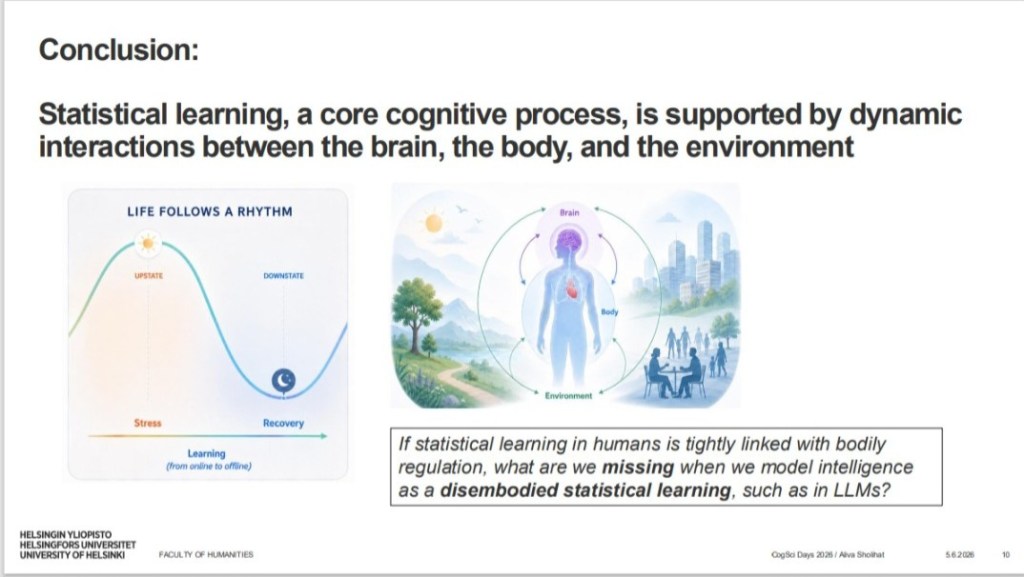
But then my empirical finding adds another layer. In my work, statistical learning is constrained by bodily regulation. In my study, statistical language learning was not only predicted by the input itself. It was also linked with bodily regulation, especially autonomic regulation in a stressful context, measured through heart rate variability. So learning was not just “the brain extracting probabilities from speech.” It was shaped by interactions between the brain, the body, and the environment or context.
And this is where I think the idea gets interesting.
If Simon says rationality is bounded by limited information, limited time, and limited computation, and his focus is mostly on cognitive limits, I think we have empirical evidence to argue that learning is also physiologically bounded. The human learner is not just a brain in a jar. The learner is a living body regulating stress, energy, arousal, recovery, and safety.
So the same speech stream may not be the same learning environment for every nervous system.
The body helps determine whether we are ready to learn, whether the signal is usable, whether the organism can extract structure from the input. So maybe statistical learning, as one mechanism of bounded rationality, is also physiologically bounded.
Then this weekend, while reading David Epstein’s book, the same idea appeared again, but through creativity.
Epstein uses Simon a lot. He talks about satisficing, bounded rationality, and how constraints can actually support creativity. One part that is interesting is his discussion of Simon’s idea that “creativity is not some privileged kind of thought that is free from constraint. It is still normal problem-solving, but directed at a specific and interesting problem.”
He has tons of anecdotal evidence throughout his book about how constraints support creativity. But I love his example of haiku the most.
Haiku is so small. Three lines. Very limited. But because it is limited, you cannot pretend to maximize. You cannot wander forever. You have to make do with what is there. You notice. You choose. You iterate. The constraint pulls you into the present.
I think that is beautiful.
Because again, the same pattern appears. Infinite freedom does not automatically create intelligence. Infinite possibility does not automatically create creativity. Sometimes, without a constraint, there is no shape. No direction. No reason to choose one thing over another.
Thinking needs edges. Creativity needs a box. Rationality needs limits. Relevance needs a frame. Human intelligence needs a body.
And this is where I think the question that is relevant for many of us parents, education in the age of AI, becomes very important.
Because AI gives us an almost infinite space of outputs. Infinite essays, summaries, images, arguments, explanations, plans, answers. So the problem is no longer only access to information. The problem is relevance.
What question should we ask?
Which answer should we trust?
What should we ignore?
What is worth doing?
What kind of life does this tool serve?
So I don’t think education in the age of AI should be about eliminating every human limitation. It should not be about making children into frictionless optimizing machines. Not in the transhumanist sense of “human superpower,” where the dream is to overcome all weakness and become almost machine-like. (What were they thinking, those billionaires who want to live forever?)
I think it is almost the opposite.
It is about acknowledging our human limitations more honestly.
Of course, not all limitations are good. Chronic stress, poverty, sleep deprivation, trauma, loneliness, fear, digital overstimulation, living under an authoritarian regime, they are not superpowers. Those are harmful constraints. They damage the conditions for learning and flourishing.
But there are also meaningful constraints. Rhythm. Rest. Attention. Bodily regulation. Moral values. Real relationships. Honest struggle. The fact that our time in this world is limited, but the afterlife is eternal. We can prioritize which problems are worth solving.
These do not make us less free. They give freedom a shape.
And maybe this is something spiritual traditions have always understood. In the Qur’an, human weakness and limitation are often placed side by side with human dignity, potential, responsibility, and possibility. Humans are weak, forgetful, hasty, dependent. But humans are also honored, taught, entrusted, capable of knowing, choosing, repenting, and coming close to the divine source.
Human limitation is not just a defect. It tells us our place in reality. We are not all-knowing. We are not all-powerful. We are not self-sufficient. We are bounded beings who must learn what matters, act with intention, and carry knowledge as a trust.
So maybe education in the age of AI is not about helping children escape their humanity.
It is about helping them inhabit it wisely.
To use AI, but not outsource relevance to it. A simple heuristic: human first, AI second, human final. We come up with the idea and the framing of the problem, AI assists us in whatever way ethical, and we remain the final editor. To use tools, but not surrender our human judgment. To be creative, not by having infinite options, but by learning which constraints are meaningful.
So maybe our bounds are our superpower not because weakness is good in itself. But because our limits force the most human question:
What actually really matters?
 livalearning